Table of Contents
- Introduction
- The Foundation: Why Play is the Best Speech Therapy
- Setting the Stage: The Do’s and Don’ts of Home Practice
- Speech Activities for the Early Years: Birth to 2 Years
- Expanding the World: Activities for 2 to 4 Years
- Refining Skills: Activities for 4 to 6 Years
- The I'm the Chef Too! Approach to Language
- Practical Tips for Parents: How to Stay Consistent
- Case Study: A Weekend of Edutainment
- When to Consult a Professional
- Summary of Key Takeaways
- Frequently Asked Questions (FAQ)
- Conclusion
Introduction
Have you ever watched your toddler struggle to tell you something, their little face scrunched in concentration, only for them to point and grunt in frustration? It is a moment every parent knows well—the bridge between wanting to communicate and having the words to do it. We often think of speech as a formal milestone, something that happens on a schedule, but in reality, language is a vibrant, living thing that grows best in the soil of play and connection.
At I’m the Chef Too!, our mission is to blend food, STEM, and the arts into one-of-a-kind "edutainment" experiences. We believe that the best way to spark curiosity and creativity is through hands-on adventures. Whether you are mixing a batch of cookies or exploring the stars, every moment is an opportunity for a "language explosion." We are committed to facilitating family bonding and providing a screen-free educational alternative that makes learning feel like the treat it truly is.
In this blog post, we are going to dive deep into the world of toddler speech therapy activities. We will cover everything from simple sound games for the littlest learners to complex storytelling for older preschoolers. We will explore the "Do's and Don'ts" of home practice, how to turn your kitchen into a language lab, and how to use everyday chores like laundry to build a robust vocabulary. By the end of this guide, you will have a full toolbox of playful strategies to support your child’s communication journey.
Our goal isn't just about reaching milestones; it is about fostering a love for learning, building your child's confidence, and creating joyful family memories. While we are experts in making learning delicious and fun, we always frame kitchen activities with the understanding that adult supervision and safety come first. Ready for a new adventure every month? Join The Chef's Club and enjoy free shipping on every box to keep the learning and the conversation flowing all year long.
The Foundation: Why Play is the Best Speech Therapy
Before we get into the "how-to" of specific activities, it is important to understand the "why." Why do speech-language pathologists (SLPs) spend so much time playing with toys instead of using flashcards? It is because toddlers are wired to learn through experience. When a child is engaged in play, their brain is in a state of high plasticity—meaning it is ready to soak up new information, forge new neural pathways, and store vocabulary in a way that "sticks."
At I’m the Chef Too!, we use this same philosophy. We teach complex subjects through tangible, hands-on, and delicious cooking adventures developed by mothers and educators. When a child is measuring flour or watching a cake rise, they aren't just learning "science"; they are learning the words for "heavy," "light," "hot," "change," and "more." These are functional words—words they can use immediately to describe their world.
Speech therapy activities for toddlers work best when they don't feel like "work." If a child feels pressured to perform, they may shut down. However, if they are trying to get a bubble to pop or a toy car to "go," the motivation to speak comes from within. This internal motivation is the secret ingredient to successful language development.
Setting the Stage: The Do’s and Don’ts of Home Practice
When you begin incorporating toddler speech therapy activities into your daily routine, it is helpful to have a roadmap. Not every moment is the right moment for practice. Here is how we recommend setting the stage for success.
DO: Pick the Right Time
The best time to practice is when your child is "regulated." This means they are well-fed, well-rested, and in a pleasant mood. Think about your child’s natural rhythm. Are they most energetic after breakfast? Do they get a second wind after an afternoon nap? Create a routine where you focus on language during these high-engagement windows.
DON’T: Force it During Meltdowns
If your child is hungry, tired, or sick, their brain is focused on survival, not learning new words. Trying to practice "articulation" during a tantrum will only lead to frustration for both of you. It is perfectly okay to abandon the plan and try again later.
DO: Keep it Short and Sweet
For toddlers, their attention span is usually measured in minutes, not hours. Aim for 10 to 30 minutes of intentional practice. The beauty of language is that it can be woven into the whole day, so three 10-minute "bursts" of play are often more effective than one long, exhausting hour.
DON’T: Try to Teach Everything at Once
It is tempting to want to fix every sound or teach fifty new words in a week. Instead, pick one or two specific goals. Maybe this week you are focusing on the "m" sound, or perhaps you are working on the word "help." Focusing on a narrow goal helps you see progress faster and keeps your child from feeling overwhelmed.
If you find yourself needing a structured way to keep these sessions exciting, give the gift of learning that lasts all year with a 12-month subscription to our STEM cooking adventures. Having a new theme delivered to your door every month provides a natural "reset" and fresh vocabulary to explore.
Speech Activities for the Early Years: Birth to 2 Years
In the earliest stages, speech therapy is all about "pre-verbal" skills. This includes eye contact, turn-taking, and sound imitation. Your goal is to show your baby that making sounds is a way to interact with their favorite people.
1. The Mirror Imitation Game
Babies are fascinated by faces—especially their own! Stand in front of a mirror with your little one. Make silly faces, stick out your tongue, or puff out your cheeks. Wait for them to try to copy you. Once they are copying your movements, add simple sounds like "ba," "ma," or a "raspberry" sound with your lips. This helps them become aware of how their mouth moves to create different effects.
2. Narrating the "Boring" Stuff
You might feel silly talking to a baby who can't talk back, but this is one of the most powerful things you can do. Narrate your day like you are a sports commentator. "Now we are putting on the blue socks. One foot, two feet! Now we go to the kitchen to find the yellow bowl." This constant stream of language helps them build a "receptive" vocabulary—the words they understand even before they can say them.
3. Animal Sound Safari
Animal sounds are often easier for toddlers to produce than actual words. They are usually made of simple consonant-vowel combinations (like "moo"). Use figurines or picture books and emphasize the sound over the name. "Look at the cow. The cow says... MOOOO." Hold the toy near your mouth so they can see how your lips form the sound.
4. The "Ready, Set... Go!" Routine
Predictability is a toddler's best friend. Use the phrase "Ready... Set... Go!" before any exciting action, like pushing them on a swing or releasing a wind-up toy. After doing this a dozen times, start pausing. Say "Ready... Set..." and then look at them expectantly. Wait. Even a small grunt or an excited wiggle counts as a "response" in the beginning. Eventually, they will try to fill in the "Go!"
Expanding the World: Activities for 2 to 4 Years
Between the ages of 2 and 4, children often experience a "language explosion." They start moving from single words to short phrases and begin to understand more complex concepts like categories and opposites.
1. The Choice Game
Instead of asking "What do you want to drink?" (which is an open-ended and difficult question), offer two specific choices. "Do you want milk or juice?" This provides them with the vocabulary they need to answer. It empowers them to use their words to exert control over their environment, which is highly motivating for a two-year-old!
2. The Laundry Sorting Challenge
Who knew chores could be one of the best toddler speech therapy activities? As you fold laundry, have your child "help" sort the piles. "This is Mommy's shirt. This is Bodhi’s sock." You can practice possessives (Mommy’s, Daddy’s), categories (socks vs. pants), and colors. If they put a sock in the wrong pile, make it a joke! "Oh no! Does this tiny sock belong to Daddy? No! That’s silly!"
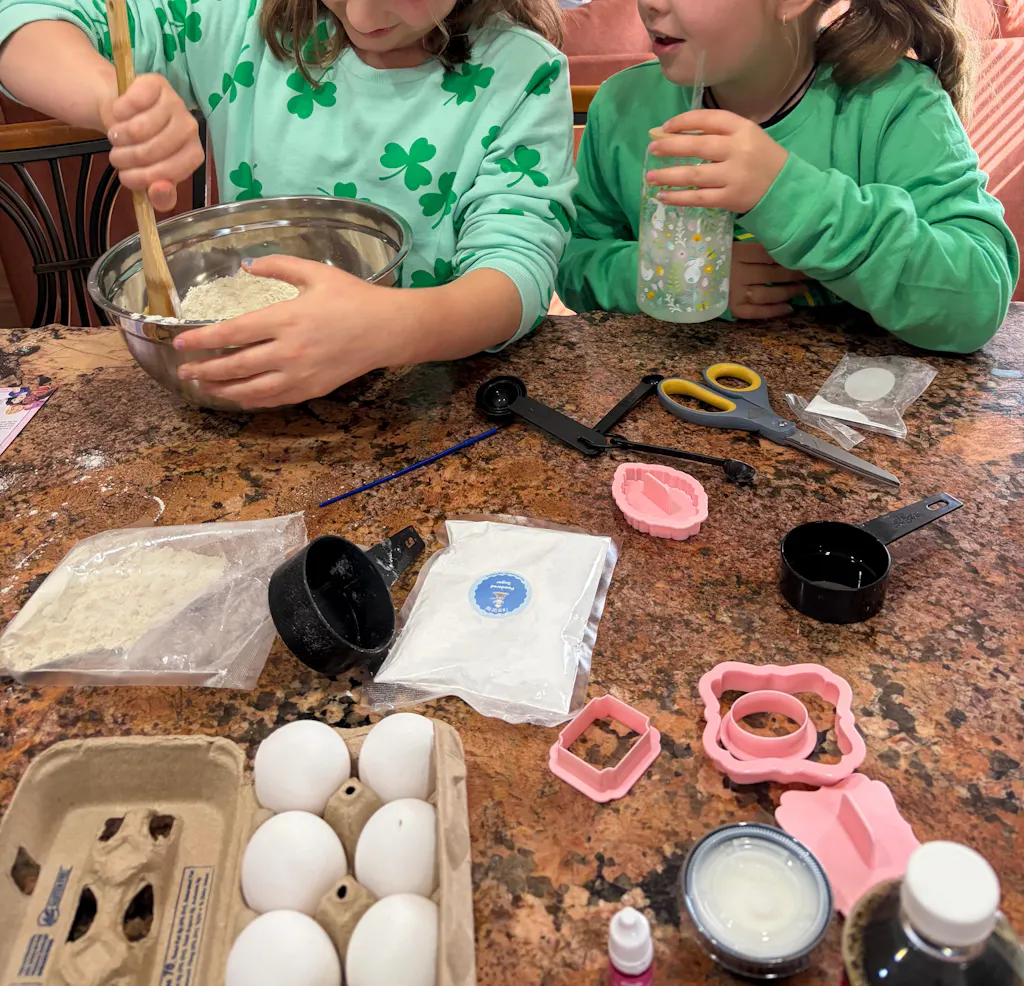
3. Kitchen STEM: Measuring and Mixing
The kitchen is a natural laboratory for speech. While you are cooking, use descriptive words that hit all the senses. "The flour is white and soft." "The butter is cold and hard." If you are looking for a way to make this even more engaging, find the perfect theme for your little learner by browsing our complete collection of one-time kits. Each kit is designed to prompt these kinds of conversations.
4. Expanding on Their Words
If your child says "Car!", you can expand that into a full thought. "Yes, a big red car! The car is going fast." This "Plus One" rule (taking what they say and adding one or two words) helps model how to build sentences without correcting them directly.
5. Bubbles with Purpose
Bubbles are a speech therapist's "secret weapon." They are visually stimulating and provide endless opportunities for requesting. Blow a few bubbles, then close the jar. Wait for your child to ask for "more" or "bubbles." You can also practice the "p" sound by saying "Pop! Pop! Pop!" every time a bubble bursts.
Refining Skills: Activities for 4 to 6 Years
By this age, many children are working on more complex speech sounds (like "r," "l," or "th") and learning how to tell cohesive stories. They are also starting to follow multi-step directions.
1. I Spy with a Twist
The classic game of "I Spy" is perfect for categorization. You can say, "I spy with my little eye something that is a fruit," or "I spy something that starts with the 'S' sound." This encourages them to scan their environment and retrieve specific words from their memory.
2. Barrier Games
This is a fantastic way to work on giving and following directions. Sit back-to-back with your child. Give them a piece of paper and some crayons, and take a set for yourself. You give instructions like, "Draw a big yellow sun in the corner," and they have to follow along without seeing your page. Then, switch roles! It’s often hilarious to see the "masterpiece" you end up with when a five-year-old gives the directions.
3. Storytelling Dice or Cards
Use pictures to help your child create a narrative. You can find "story cubes" or simply cut out pictures from a magazine. Have them pick three pictures and tell a story that connects them. This helps with the concept of "Beginning, Middle, and End," which is a foundational literacy skill.
4. Kitchen Chemistry and Conversation
Older kids love the "wow" factor of science. For example, you can explore geology and chemical reactions together as a family. We love seeing the excitement of a chemical reaction that makes our Erupting Volcano Cakes bubble over with deliciousness. As the "lava" flows, ask your child to describe the process. "What happened when we added the liquid? Why did it fizz?" This encourages higher-level thinking and descriptive language.
The I'm the Chef Too! Approach to Language
At I’m the Chef Too!, we believe that the kitchen is the heart of the home, and it is also the best classroom. Our kits are developed by educators and mothers who understand that children learn best when they are "doing."
When you use one of our kits, you aren't just following a recipe; you are engaging in a multi-sensory educational adventure.
- Tactile: Kneading dough, feeling the grit of sugar, or the smoothness of icing.
- Visual: Watching colors change and liquids turn to solids.
- Auditory: Listening to the timer "beep," the mixer "whir," or the sizzle of a pan.
- Gustatory/Olfactory: Smelling the cinnamon and tasting the final product!
This multi-sensory input creates more "hooks" in the brain for new words to latch onto. For instance, you could explore astronomy by creating your own edible solar system with our Galaxy Donut Kit. As you swirl the "galactic" icing, you can talk about planets, orbits, and the colors of the nebula. This is STEM and speech therapy rolled into one delicious donut!
Practical Tips for Parents: How to Stay Consistent
Consistency is the most important factor in any developmental journey. However, we know that life is busy. You don't need to set aside "speech time" to be an effective teacher. Here is how to integrate these toddler speech therapy activities into a hectic schedule:
Use the "Wait Time" Technique
As parents, we often anticipate our children's needs before they even speak. We see them looking at the milk and we give it to them. To encourage speech, try waiting for 5 to 10 seconds. Give them the space to realize they need to communicate. This "expectant pause" is often enough to nudge them to try a word.
Reduce Screen Time
While some educational shows are great, they are "passive" experiences. Speech is "active." By choosing a screen-free educational alternative like our kits, you are ensuring that your child is interacting with a person, not a tablet. Real-life conversation requires turn-taking and reading facial expressions—skills that a screen simply cannot teach.
Make it a Family Affair
Speech practice shouldn't just be between one parent and the child. Get siblings involved! Older siblings love being the "teacher" and can be excellent models for speech. Ready for a new adventure every month? Join The Chef's Club and enjoy free shipping on every box, making it easy to involve the whole family in a monthly tradition of learning and laughter.
Case Study: A Weekend of Edutainment
Imagine a Saturday morning. Instead of turning on the TV, a family decides to open their I'm the Chef Too! box.
The Scene: A parent and their 3-year-old are working on a kit. The Activity: Making "Wild Turtle Whoopie Pies." The Speech Opportunities:
- Vocabulary: "Turtle," "shell," "green," "sticky," "sweet."
- Action Words: "Scoop," "stir," "bake," "wait."
- STEM Connection: Discussing how turtles have shells for protection while shaping the treats.
- Social Skills: Taking turns adding the ingredients.
Even beloved animals can make learning fun, like when kids make Wild Turtle Whoopie Pies. By the time the treats are out of the oven, the child has heard and used dozens of functional words in a context that was purely joyful. This is the essence of "edutainment."
When to Consult a Professional
While at-home activities are incredibly beneficial, they are a supplement to, not a replacement for, professional help when it's needed. Every child develops at their own pace, but there are some signs that a consultation with a Speech-Language Pathologist (SLP) might be helpful:
- By 12 months: Not babbling or using gestures like waving.
- By 18 months: Prefers gestures over vocalizations to communicate.
- By 2 years: Can only imitate speech but doesn't produce words or phrases spontaneously.
- By 3 years: Speech is very difficult for even family members to understand.
- Any age: If your child shows extreme frustration when trying to communicate or if they have lost skills they once had.
Early intervention is wonderful because it takes advantage of that early brain plasticity we mentioned earlier. An SLP can provide you with even more specific toddler speech therapy activities tailored to your child's unique needs.
Summary of Key Takeaways
Helping your child find their voice is one of the most rewarding parts of being a parent. Here are the most important points to remember:
- Play is the Work of Childhood: Use toys, bubbles, and games to make communication fun and low-pressure.
- Follow the Child's Lead: Practice when they are happy and engaged, and stop when they are tired.
- Daily Routines are Learning Goldmines: Turn laundry, bath time, and grocery shopping into language lessons.
- The Kitchen is a Language Lab: Cooking provides multi-sensory input that helps vocabulary stick.
- Consistency over Intensity: 10 minutes of daily playful interaction is better than a once-a-week marathon.
At I’m the Chef Too!, we are honored to be a part of your family’s educational journey. We know that by providing hands-on, screen-free adventures, we are helping you create an environment where language can flourish naturally. Give the gift of learning that lasts all year with a 12-month subscription to our STEM cooking adventures and watch your child’s confidence—and their vocabulary—grow.
Frequently Asked Questions (FAQ)
1. How many words should my 2-year-old have?
While there is a wide range of "normal," most 2-year-olds have about 50 words and are starting to put two words together (like "more juice" or "Mommy go"). If you have concerns, it is always best to chat with your pediatrician or an SLP.
2. Does using "baby talk" hurt my child's speech?
It's actually okay to use "parentese"—that high-pitched, sing-song way we talk to babies. It helps them tune into the sounds of language. However, try to use the correct names for things alongside the silly ones. For example, "Time for din-din! Let's eat your dinner."
3. My child understands everything but won't talk. What can I do?
This is often called a "receptive-expressive gap." Focus on "communication temptations." Put a favorite toy in a clear container they can't open, so they have to ask for "help" or "open."
4. Are flashcards good for toddler speech therapy?
Flashcards can be okay for older kids, but for toddlers, they are often too static. Real objects (like a real apple or a toy cow) are much better because the child can touch, smell, and move them, which builds a stronger connection in the brain.
5. How can I get my child to stay focused on an activity?
Keep it movement-based! If you are working on the word "jump," actually jump together. If you are cooking, let them be hands-on with the stirring and pouring. Not ready to subscribe? Explore our full library of adventure kits available for a single purchase in our shop to find a theme that matches your child's current obsession, whether it's dinosaurs, space, or unicorns!
6. Can cooking really help with speech?
Absolutely! Cooking involves following directions (receptive language), describing textures and tastes (descriptive language), and requesting ingredients (expressive language). It’s a natural, high-motivation environment for practicing all kinds of communication skills.
Conclusion
The journey of speech development is a marathon, not a sprint. Every "coo," every "ba," and every messy kitchen "adventure" is a step forward. By incorporating these toddler speech therapy activities into your daily life, you are doing more than just teaching words; you are building a foundation of confidence and connection that will last a lifetime.
At I’m the Chef Too!, we are proud to support parents and educators with tools that blend food, STEM, and the arts into unforgettable experiences. We believe that when children are having fun, they are learning—and when they are learning, they are thriving. Our kits are designed to spark that curiosity and give you the perfect platform for meaningful conversation.
Ready to start your next learning adventure? Whether you want to explore the galaxy or bake a volcano, we have everything you need to make home learning delicious and educational. Ready for a new adventure every month? Join The Chef's Club and enjoy free shipping on every box. Let’s get cooking, talking, and learning together!