Table of Contents
- Introduction
- What is a Winter STEM Challenge and Why Does It Matter?
- The Magic of Culinary STEM: Blending Food, Science, and Fun
- Our Favorite Winter STEM Challenges (with a Delicious Twist!)
- Tips for a Successful Winter STEM Challenge Experience
- Why Choose I'm the Chef Too! for Your Winter Adventures?
- Bringing STEM to Groups: Schools, Camps, and Beyond
- Conclusion
- FAQ Section
The quiet hush of freshly fallen snow, the cozy warmth of a home, and... the inevitable chorus of "I'm bored!" from energetic little ones. Winter, with its shorter days and indoor focus, often presents a unique challenge for parents and educators alike: how do we keep young minds engaged, curious, and active when the great outdoors might be too chilly for extended play? Instead of succumbing to endless screen time or the winter blues, we see this season as a golden opportunity for discovery. This post is your comprehensive guide to transforming those frosty days into thrilling adventures with engaging winter STEM challenges. We’re here to show you how blending the magic of science, technology, engineering, and math – especially with a delicious culinary twist – can spark unparalleled curiosity, creativity, and joy in children, all while building crucial skills and creating cherished family memories.
Introduction
Winter has a special charm, a season of quiet beauty, twinkling lights, and the promise of hot cocoa. But for parents and educators, it can also be a time of heightened energy indoors, where children, brimming with curiosity, often look for new ways to explore and learn. The quest for screen-free, educational activities becomes paramount. That's precisely where the magic of winter STEM challenges comes in. Imagine turning your kitchen or classroom into a vibrant laboratory where everyday ingredients become tools for scientific discovery, engineering feats, and mathematical marvels. At I'm the Chef Too!, our mission is to blend food, STEM, and the arts into one-of-a-kind "edutainment" experiences, proving that learning can be both tangible and incredibly delicious. This blog post will dive deep into the world of winter STEM, providing you with practical, fun, and engaging ideas that go beyond traditional playtime, fostering a love for learning, building confidence, and developing key skills in your children. Get ready to transform ordinary winter days into extraordinary learning adventures, one delicious experiment at a time!
What is a Winter STEM Challenge and Why Does It Matter?
Before we dive into the delicious details, let's clarify what we mean by a winter STEM challenge. STEM stands for Science, Technology, Engineering, and Math, and these challenges are hands-on activities that encourage children to explore concepts from these four interconnected fields. When we add "winter" to the mix, we simply ground these explorations in the themes and phenomena of the season – think snow, ice, cold, hibernation, holiday traditions, and the joy of indoor creativity.
Why are these challenges so important, especially during the colder months?
- Combating Cabin Fever: Long stretches indoors can lead to restlessness. STEM challenges provide a focused, active outlet for children's energy and curiosity, transforming idle time into productive play.
- Developing Critical Thinking and Problem-Solving: Unlike activities with a single "right" answer, STEM challenges encourage experimentation, trial-and-error, and creative solutions. Children learn to analyze problems, brainstorm ideas, design, test, and refine their approaches, building resilience and adaptability.
- Fostering Creativity and Innovation: Many STEM challenges are open-ended, allowing children to express their unique ideas and design solutions. This process nurtures their innate creativity, showing them that there's more than one way to achieve a goal.
- Building Foundational Skills: From measuring ingredients (math) and observing reactions (science) to constructing stable structures (engineering) and using simple tools (technology), these activities naturally develop a wide range of academic and practical skills. Fine motor skills, spatial reasoning, and logical deduction are all put to the test.
- Encouraging Collaboration and Communication: When children work together on a challenge, they learn to share ideas, listen to others, negotiate, and communicate their thoughts effectively. These are invaluable social skills that extend far beyond the kitchen or classroom.
- Promoting Screen-Free Engagement: In a world increasingly dominated by digital devices, hands-on STEM activities offer a refreshing and meaningful alternative. They provide a sensory-rich experience that engages multiple senses and fosters a deeper connection with the physical world.
- Facilitating Family Bonding: There's something truly special about working on a project together. Winter STEM challenges offer a wonderful opportunity for parents, siblings, and children to collaborate, share laughter, and create lasting memories. It’s about the shared experience of discovery, not just the outcome.
At I'm the Chef Too!, we wholeheartedly embrace this philosophy. We believe that the best learning happens when it's engaging, hands-on, and relevant to a child's world. Our unique approach of teaching complex subjects through tangible, and often delicious, cooking adventures is developed by mothers and educators who understand the importance of sparking curiosity and creativity in children. We’re committed to facilitating family bonding and providing screen-free educational alternatives that truly make learning fun.
The Magic of Culinary STEM: Blending Food, Science, and Fun
When you combine STEM with cooking, something truly magical happens. Food isn't just a treat; it becomes an incredible medium for hands-on learning, appealing to all five senses and making abstract concepts wonderfully tangible. For children, the kitchen transforms into a vibrant, exciting laboratory, where every ingredient, every mix, and every bake is an experiment waiting to unfold.
Why is cooking such a powerful tool for STEM education?
- Sensory Engagement: Unlike many traditional classroom activities, cooking engages sight, smell, touch, taste, and even sound! This multi-sensory experience helps children process and retain information more effectively, making learning memorable and enjoyable.
- Real-World Application: Cooking is a fundamental life skill, and incorporating STEM into it shows children the direct relevance of these subjects to their daily lives. They see how math is essential for measuring, how science explains why cakes rise, and how engineering plays a role in constructing a gingerbread house.
- Immediate and Delicious Results: The best part? At the end of a culinary STEM challenge, there's often something tasty to enjoy! This immediate reward reinforces positive learning experiences and motivates children to explore further. Who wouldn't want to learn about chemical reactions when it results in a fluffy cupcake?
- Natural Problem-Solving: Cooking doesn't always go according to plan, and that's okay! A recipe might need adjustment, or an ingredient might behave unexpectedly. These "kitchen mishaps" become valuable problem-solving opportunities, teaching adaptability and perseverance.
- Encourages Patience and Following Instructions: While creativity is key, cooking also teaches the importance of precision and sequence. Children learn to follow steps, measure accurately, and understand that sometimes, good things come to those who wait (especially when baking!).
At I'm the Chef Too!, this blend of food, STEM, and the arts is at the heart of everything we do. Our kits are designed to be "edutainment" experiences that not only teach scientific principles or mathematical concepts but also encourage artistic expression through decoration and presentation. Developed by mothers and educators, our delicious cooking adventures are crafted to spark curiosity, facilitate family bonding, and provide a much-needed screen-free alternative. We focus on the benefits of the process: fostering a love for learning, building confidence, developing key skills, and creating joyful family memories that will last long after the last bite. We want children to understand that they are capable of incredible things, both in the kitchen and beyond.
Ready for a new adventure every month, delivered right to your door? Join The Chef's Club and enjoy free shipping on every box. It's the perfect way to keep the learning and delicious fun going all winter long!
Our Favorite Winter STEM Challenges (with a Delicious Twist!)
Now, let's explore some fantastic winter STEM challenges that incorporate the fun and magic of food, making them perfect for those chilly days. Remember, safety first! Always ensure adult supervision when working in the kitchen, especially with ovens, hot liquids, or sharp tools.
1. Edible Igloo Engineering Challenge
Concept: Engineering (structure, stability, materials), Math (geometry, spatial reasoning), Science (insulation, melting).
The Challenge: Can your child design and build the most stable and tallest igloo using edible materials? You can add a twist: which igloo can best protect a small piece of chocolate from melting when placed near a warm light for a set amount of time?
How to Play:
- Materials: Large marshmallows, mini marshmallows, graham crackers (for base), pretzel sticks (for structural support), toothpicks, royal icing or melted white chocolate (as "mortar").
- The Build: Encourage children to sketch out their designs first. Discuss shapes (circles, domes), how individual "bricks" (marshmallows) fit together, and the importance of a strong foundation. Pretzel sticks can be used to add internal support, demonstrating tension and compression.
- The Science Twist: If you're going for the melting challenge, discuss insulation. Which materials might keep the inside cooler? How does the shape of the igloo contribute?
- Learning Outcomes: Children will experiment with different building techniques, learn about the strength of arches and domes, and understand the properties of various materials. They'll also practice measurement and fine motor skills.
2. Glacial Goo & Icy Eruptions: A Chemistry Concoction
Concept: Chemistry (non-Newtonian fluids, acid-base reactions, states of matter), Science (observation, prediction).
The Challenge: Create a "melting snowman" or "icy pond" oobleck that can be sculpted, then observe what happens when you introduce a chemical reaction!
How to Play:
- Edible Oobleck: Mix cornstarch with water (add a few drops of blue food coloring for an "icy" pond or leave white for "snow"). This creates a non-Newtonian fluid – sometimes a solid, sometimes a liquid! Kids can try to form snowmen or icebergs. Discuss the unique properties of this fluid.
- Icy Eruptions: In a separate bowl, place a few tablespoons of baking soda. Add a few drops of dish soap and blue food coloring. Using a dropper or spoon, add vinegar (the "acid") and watch the "snow" erupt! Discuss the gas (carbon dioxide) produced by the acid-base reaction.
- I'm the Chef Too! Connection: This is a perfect example of the exciting chemical reactions we explore in our kits. For a truly explosive (and delicious) experience, you can explore making our Erupting Volcano Cakes Kit. It's a real-life chemical reaction that makes cakes bubble over with deliciousness!
- Learning Outcomes: Children learn about different states of matter, the nature of chemical reactions, and the scientific method of observation and prediction.
3. Crystallized Winter Wonderland: Edible Bling!
Concept: Chemistry (solutions, saturation, crystallization, solubility), Science (observation).
The Challenge: Grow your own edible "ice crystals" and understand how beautiful structures form from simple ingredients.
How to Play:
- Materials: Water, granulated sugar, string, pencil or clothespin, glass jars.
- The Process: Heat water and dissolve as much sugar as possible, creating a super-saturated solution. Let it cool slightly. Tie a piece of string to a pencil, letting the string hang into the jar without touching the bottom or sides. Suspend the pencil across the mouth of the jar. Over several days, watch as sugar crystals form along the string, growing into beautiful rock candy!
- Learning Outcomes: Children will observe the process of crystallization, learn about saturated solutions, and understand how temperature affects solubility. It's a fantastic lesson in patience and observation.
4. Winter Wonderland Bridge or Sled Engineering
Concept: Engineering (load-bearing, structural integrity, friction), Math (measurement, weight), Science (force, motion).
The Challenge: Design and build a bridge or sled using edible materials that can support the most weight or travel the farthest distance.
How to Play:
- Materials: Graham crackers, gingerbread pieces, pretzel sticks, candy canes, royal icing or melted chocolate (as "glue"), small weights (coins, marbles, or small candies for testing).
- Bridge Building: Encourage children to build a bridge between two "banks" (e.g., two stacks of books). They can experiment with different bridge designs (arch, truss, beam) and see which supports the most weight before collapsing. Discuss why certain shapes are stronger.
- Sled Design: If building sleds, provide a ramp (cardboard or a cookie sheet propped up). Children design sleds, considering the runners and the body, to see which travels the farthest or fastest. Discuss friction and gravity.
- Learning Outcomes: This challenge directly engages children in the engineering design process: planning, building, testing, and redesigning. They learn about forces, structural stability, and the properties of materials.
5. Snowflake Geometry Bake-Off
Concept: Math (symmetry, geometry, patterns, fractions), Art (design, decoration), Science (baking principles).
The Challenge: Create symmetrical snowflake designs on cookies or pies, exploring geometric shapes and patterns.
How to Play:
- Materials: Snowflake-shaped sugar cookies or small pie crusts, royal icing in various colors, sprinkles, small candies.
- Design & Decorate: Before decorating, discuss what symmetry means. Look at pictures of real snowflakes. Challenge children to create designs that are symmetrical (the same on all sides) or to use repeating geometric patterns. They can divide their cookies into "fractions" to ensure even designs.
- I'm the Chef Too! Connection: Even beloved characters can make learning fun. Children can explore patterns and delicious design by making Peppa Pig Muddy Puddle Cookie Pies, where they can practice symmetry with edible elements.
- Learning Outcomes: Children strengthen their understanding of geometric concepts, practice fine motor skills, and explore artistic expression, all while engaging in a delightful baking activity.
6. "Keep it Cool" Insulated Cupcakes
Concept: Science (insulation, heat transfer, states of matter), Engineering (design), Math (measurement).
The Challenge: Design and build an insulated container to keep a cupcake from freezing (or melting, if you adapt for warmer climates/materials) in a cold environment.
How to Play:
- Materials: Baked cupcakes, various insulating materials (cotton balls, aluminum foil, bubble wrap, paper, fabric scraps, small cardboard boxes), thermometers (optional).
- The Experiment: Set up a "cold environment" (e.g., outside on a cold day, or inside a freezer). Children design and construct containers around their cupcakes using the provided materials. Place a control cupcake (uninsulated) alongside the insulated ones. After a set time (e.g., 30-60 minutes), retrieve the cupcakes and discuss which one stayed warmest/least frozen. If you have thermometers, measure internal temperatures.
- Learning Outcomes: Children learn about the principles of heat transfer (conduction, convection, radiation) and how different materials act as insulators. They engage in engineering design by planning, building, and testing their solutions.
7. Galaxy Donut Science: Cosmic Culinary Creations
Concept: Astronomy (planets, galaxies), Chemistry (mixing, reactions in glazes), Art (color theory, design).
The Challenge: Create edible "galaxies" or "planets" on donuts, exploring color mixing and the science behind glaze textures.
How to Play:
- Materials: Plain donuts, powdered sugar, milk, food coloring (various colors), sprinkles (for "stars").
- The Glaze Lab: Mix powdered sugar with small amounts of milk to create a basic white glaze. Divide the glaze into several bowls and add different food colorings. Children can experiment with swirling colors together to create "galaxy" patterns, or create distinct "planets" with marbling techniques. Discuss how colors blend and separate. The science here is in the suspension of sugar particles in a liquid, creating a viscous (thick) coating that hardens as the water evaporates.
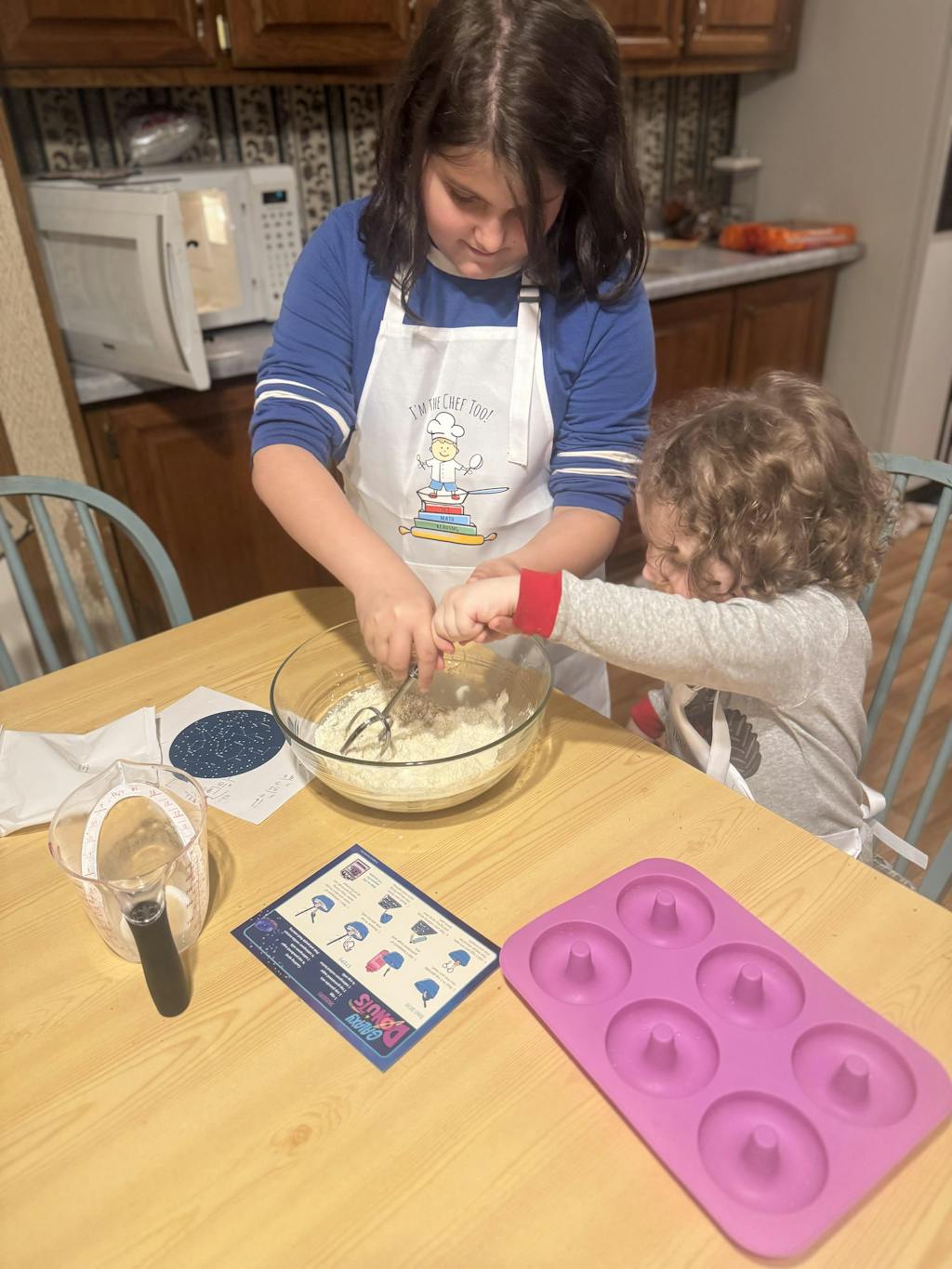
- I'm the Chef Too! Connection: This challenge perfectly mirrors the fun and learning in our Galaxy Donut Kit. Explore astronomy by creating your own edible solar system, complete with colorful glazes and delicious flavors.
- Learning Outcomes: Children engage with color theory, artistic design, and basic chemistry concepts related to solutions and viscosity, all while exploring themes of astronomy in a fun, edible way.
8. Winter Storybook Snack Engineering
Concept: Engineering (design, construction), Literacy (story comprehension, creative writing), Art (presentation).
The Challenge: After reading a winter-themed story (e.g., The Mitten, Gingerbread Man, Snowflake Bentley), design and build an edible structure or scene inspired by the book.
How to Play:
- Materials: A variety of edible items like graham crackers, pretzels, cookies, candies, fruit leathers, icing, whipped cream, small fruit pieces.
- Read & Plan: Read a winter story aloud. Discuss the settings, characters, and any challenges faced. Then, challenge children to engineer an edible representation. For The Mitten, perhaps they build a "mitten" of bread with small animal crackers nestled inside. For The Gingerbread Man, build an edible "house" or "bridge" he could cross.
- Learning Outcomes: This challenge integrates literacy with engineering, encouraging comprehension, creative problem-solving, and fine motor skills. It allows children to connect stories to tangible creations.
These are just a few ideas to get you started. The beauty of winter STEM challenges, especially with food, is their adaptability. You can adjust the complexity, materials, and learning focus to suit your child's age, interests, and the resources you have on hand. What matters most is the process of discovery and the joy of creating together.
Not ready to subscribe for monthly deliveries? We understand! You can still dive into amazing adventures with us. Browse our complete collection of one-time kits and find the perfect theme for your little learner!
Tips for a Successful Winter STEM Challenge Experience
Embarking on a winter STEM challenge can be incredibly rewarding, but a little preparation and the right mindset can make all the difference. Here are our top tips for ensuring a successful and joyful experience for everyone:
- Prioritize Safety (Adult Supervision is Key!): Especially when working in the kitchen, always ensure adult supervision. This includes handling ovens, stovetops, sharp utensils, and anything hot. Talk about kitchen safety rules before you begin. At I'm the Chef Too!, we always frame kitchen activities with an implicit understanding of adult supervision and safety.
- Embrace the Mess: Let's be honest, cooking and experimenting with kids can get messy! Lay down newspaper, use washable mats, and have wipes or towels readily available. View the mess as a sign of active engagement and deep learning, not a hindrance. A little flour on the counter means a lot of fun was had!
- Focus on the Process, Not Just the Product: The goal isn't always to create a perfect, Instagram-worthy masterpiece. The true value of STEM lies in the thinking, planning, trying, and learning that happens along the way. Celebrate the effort, the creativity, and the discoveries, even if the "final product" isn't exactly as planned. This fosters a love for learning and resilience.
- Encourage Experimentation and "Failure": Sometimes the first (or fifth!) attempt won't work out. This is a crucial part of the scientific and engineering process! Encourage children to ask, "Why didn't that work?" and "What can we try differently next time?" These moments are powerful learning opportunities, building confidence and problem-solving skills.
- Adapt to Age and Interest: Not all challenges are suitable for all ages. Simplify complex tasks for younger children (e.g., focus on sensory exploration rather than detailed measurement) and add more variables or constraints for older kids. Tailor the challenge to your child's specific interests – if they love space, lean into cosmic cooking!
- Provide Open-Ended Materials: While our kits come with everything you need, if you're doing a DIY challenge, offer a variety of materials without too many rules on how to use them. This encourages creative thinking and innovative solutions. Think outside the box: recyclables, craft supplies, and even nature finds can be great additions.
- Ask Open-Ended Questions: Instead of just telling your child what to do, engage them with questions: "What do you think will happen if...?", "How could we make this stronger/tastier/taller?", "What did you learn from this experiment?", "What surprised you?" This encourages reflection and deeper understanding.
- Document the Journey: Take photos or videos of the process. Encourage older children to keep a "STEM journal" where they can draw their designs, record their observations, and write down their conclusions. This reinforces learning and provides a wonderful keepsake of their adventures.
- Make it a Family Affair: Winter STEM challenges are fantastic opportunities for family bonding. Work together as a team, share ideas, and celebrate successes. These shared experiences create joyful family memories and reinforce the idea that learning is a fun, collaborative activity. This is central to our values at I'm the Chef Too! – fostering connections through shared discovery.
- Keep it Screen-Free: This is a fantastic chance to unplug and engage with the physical world. Emphasize the hands-on nature of the activity and encourage full immersion without digital distractions. It's a mindful way to learn and connect.
By following these tips, you can ensure that your winter STEM challenge is not just an activity, but a truly enriching and memorable experience that sparks curiosity, builds confidence, and develops valuable skills in your child.
Why Choose I'm the Chef Too! for Your Winter Adventures?
As you can see, the world of winter STEM challenges is vast, exciting, and full of delicious possibilities. But sometimes, life gets busy, and gathering all those materials and crafting detailed lesson plans can feel like another item on an already overflowing to-do list. That's where I'm the Chef Too! steps in, simplifying the process and amplifying the fun.
At I'm the Chef Too!, our unique approach is rooted in our mission: to blend food, STEM, and the arts into one-of-a-kind "edutainment" experiences. We are passionate about sparking curiosity and creativity in children, facilitating invaluable family bonding, and providing a screen-free educational alternative that truly makes learning exciting. Our team, comprised of mothers and educators, carefully designs each kit to teach complex subjects through tangible, hands-on, and utterly delicious cooking adventures.
Here's why choosing I'm the Chef Too! for your winter STEM journey is the perfect solution:
- Unrivaled Convenience: Say goodbye to endless grocery store trips and frantic searches for obscure ingredients. Each I'm the Chef Too! box is a complete experience, containing pre-measured dry ingredients and specialty supplies needed for the adventure. A new, exciting kit is delivered right to your door every month, often with free shipping in the US, making ongoing educational fun effortless.
- Expertly Curated Content: Our kits aren't just random recipes; they are carefully crafted learning experiences. From exploring geology with edible volcano cakes to delving into astronomy with galaxy donuts, each kit integrates genuine STEM concepts in an accessible and engaging way. We focus on fostering a love for learning, building confidence, developing key skills, and creating joyful family memories, rather than overpromising specific academic achievements.
- Screen-Free, Hands-On Fun: In an increasingly digital world, we offer a refreshing escape. Our kits encourage active participation, sensory exploration, and real-world interaction, providing a meaningful alternative to screen time.
- Flexibility for Every Family: Whether you're looking for a one-time activity or continuous engagement, we have options for you. Our Chef's Club offers flexible 3, 6, and 12-month pre-paid plans, perfect for consistent enrichment or as a thoughtful gift that keeps on giving all year.
- Designed for Connection: We believe the kitchen is the heart of the home, a place for connection and creation. Our kits are built to facilitate family bonding, providing a shared activity that encourages teamwork, conversation, and laughter.
Ready to transform your winter from "I'm bored" to "Let's explore!"? Give the gift of learning that lasts all year with a 12-month subscription to our STEM cooking adventures, or pick a shorter plan that fits your needs. Join The Chef's Club today and start creating delicious memories!
Not quite ready for a subscription? No problem! You can still experience the magic. Explore our full library of adventure kits available for a single purchase in our shop and pick the perfect theme to kickstart your winter STEM journey.
Bringing STEM to Groups: Schools, Camps, and Beyond
The engaging power of culinary STEM isn't just for individual families at home; it's also a fantastic resource for group settings. Imagine the buzz in a classroom, the excitement at a winter camp, or the collaborative spirit in a homeschool co-op when children are challenged to create edible science experiments or engineer delicious designs.
At I'm the Chef Too!, we understand the unique needs of educators and group leaders. Our programs are designed to bring our hands-on STEM adventures to your classroom, camp, or homeschool co-op, providing a structured yet incredibly fun learning experience for a larger audience. We offer versatile options to suit different requirements, including programs available both with and without food components, ensuring inclusivity and flexibility. Our kits simplify the logistics for group leaders by providing carefully curated activities and often pre-measured materials, allowing educators to focus on facilitating learning and enjoying the process with their students.
Whether you're looking to enhance your curriculum, provide a memorable holiday activity, or integrate unique STEM experiences into your ongoing programs, our group options are tailored to spark curiosity and foster skill development in a collective setting. It’s an ideal way to channel the excitement of winter into active, collaborative learning for every child.
To learn more about how we can bring our award-winning "edutainment" experiences to your organization, please visit our dedicated section. Learn more about our versatile programs for schools and groups, available with or without food components and let's make your group's winter learning unforgettable.
Conclusion
As the winter days unfold, let's redefine what "indoor play" means for our children. Instead of battling boredom or the allure of screens, we can embrace this season as a canvas for discovery, learning, and connection. Winter STEM challenges, especially when infused with the delicious magic of cooking, offer an unparalleled opportunity to engage young minds, spark curiosity, and build essential skills in a truly memorable way. From engineering edible igloos to exploring the chemistry of sweet crystalline structures, these activities foster critical thinking, creativity, and resilience, all while creating heartwarming family moments.
At I'm the Chef Too!, we are committed to making these enriching experiences accessible and exciting for every child and family. Our carefully designed kits blend the best of food, STEM, and the arts, transforming complex subjects into tangible, hands-on, and utterly delicious adventures. We believe in the power of shared experiences, the joy of discovery, and the lasting impact of learning together, screen-free.
So, this winter, why not trade the chill for thrilling challenges and the ordinary for extraordinary discovery? Let's turn your kitchen into a vibrant laboratory where every experiment leads to a new skill, a new insight, and a new smile.
Ready to embark on an unforgettable journey of culinary STEM this winter and beyond? The adventure awaits! Join The Chef's Club today and let us deliver a world of "edutainment" directly to your doorstep, month after month.
FAQ Section
Q1: What age are these winter STEM challenges suitable for?
A: Most winter STEM challenges, especially those with a culinary twist, can be adapted for a wide range of ages, generally from preschool through middle school. For younger children (3-6), focus on sensory exploration, simple mixing, and basic building. For elementary-aged kids (7-10), you can introduce more specific STEM concepts, measurements, and design constraints. Older children (11+) can tackle more complex problems, delve deeper into scientific principles, and conduct more precise experiments. Our I'm the Chef Too! kits are designed with age-appropriate learning in mind, often with suggestions for varying complexity.
Q2: Do I need special equipment to do these winter STEM challenges?
A: Not at all! Many winter STEM challenges can be done with everyday household items, common craft supplies, and basic kitchen ingredients. Things like paper, tape, scissors, marshmallows, pretzels, food coloring, baking soda, vinegar, and sugar are often all you need. If you're looking for curated experiences without the hassle of gathering supplies, our I'm the Chef Too! kits come with pre-measured dry ingredients and specialty supplies, making it incredibly convenient to get started.
Q3: How can I make these challenges more challenging or simpler?
A:
- To make it simpler: Reduce the number of steps, provide more direct instructions, focus on exploration rather than a specific outcome, or pre-measure some ingredients for younger children. For instance, in the "Edible Igloo" challenge, just focus on building, not the insulation test.
- To make it more challenging: Add constraints (e.g., a time limit, limited materials, specific dimensions), introduce more variables to test, require a written hypothesis or observation log, or encourage redesign based on testing results. For example, in the "Winter Wonderland Bridge" challenge, specify a minimum load it must hold and a maximum amount of material that can be used.
Q4: What if my child doesn't like cooking or trying new foods?
A: Even if a child is a picky eater, the process of cooking can still be a highly engaging STEM activity. The focus can be shifted from eating the final product to the science and engineering involved in creating it. Many kids love to bake and decorate even if they don't eat every bite. You can also let them be the "scientist" or "engineer" in charge, directing the process without necessarily tasting. Our kits are designed to be so engaging that the "edutainment" aspect often transcends initial reluctance, fostering curiosity in a low-pressure environment.
Q5: How often should we do STEM challenges?
A: The frequency depends on your family's schedule and interest. Even once a month can make a significant impact on fostering curiosity and developing skills. The key is consistency and making it a joyful, stress-free activity. Our Chef's Club subscription is designed to support a regular rhythm of discovery, delivering a new, exciting, and educational adventure to your door every month, making it easy to integrate STEM learning into your routine without extra planning.